

Preschool activity books for travelers are portable collections of coloring pages and activities that give children something playful to do away from home. For parents packing for ages 3–7, the useful choice is a book your child can enjoy in a small space, with supplies you can keep together.
- Choose preschool activity books your child can use comfortably, not pages that introduce several unfamiliar tasks.
- French Press Studios offers coloring and activity books; choose by activity type, not the cover alone.
- Pack one working book, a contained drawing kit, and a backup activity separately.
- Check printable PDFs before departure: download, print, and organize the pages you want to bring.
Why activity books matter for preschool travelers
Travel changes the conditions in which your child uses a book. A familiar kitchen table becomes a narrow tray, a shared waiting-room seat, or your lap. Your attention also shifts between helping your child and managing the trip.
Choose for the setting, not just the subject. An appealing animal theme is a starting point; the page still needs to work with the surface, supplies, and adult help you have available.
French Press Studios sells coloring and activity books for children, alongside grown-up coloring titles. Keep the children's selection separate when choosing something for a family journey.
For your 2026 travel kit, judge each option against three practical questions: Can your child understand the task? Can you manage its materials? Can you stop halfway without losing loose pieces?
Age labels help you start browsing, but inspect the actual pages whenever previews are provided. A child who enjoys coloring at home does not automatically want a page full of unfamiliar instructions during a journey.
How to pack preschool activity books for travel
1. Match the pages to familiar play
Start with what your child already chooses at home. Look through books you own, or make a simple page on plain paper, before buying anything new. Drawing a few familiar shapes gives you a straightforward way to see what your child wants to do.
For ages 3–7, avoid treating one age recommendation as a promise that every page will fit. Choose the activity your child enjoys now, whether that means coloring an animal, following a simple path, or drawing something from the window.
Familiar play belongs at the front of the travel kit. Save an unfamiliar task for a moment when you can sit together and explain it, rather than expecting your child to work it out while you handle boarding.
- Notice favorites: Pick an activity your child returns to willingly.
- Check instructions: Read a sample task aloud before packing.
- Offer choice: Let your child select between two suitable themes.
- Allow skipping: Leave out pages that already cause frustration at home.
2. Test the book on a small surface
Give the book a practice outing at home. Place it on a small tray or a clear corner of a table, then add the supplies you intend to bring. Watch what happens when your child turns a page or reaches for another color.
This is a fit check, not a test of your child. Notice whether you must hold the book open, move the supplies repeatedly, or retrieve pieces from the floor. Those are packing problems you can address before departure.
In your 2026 packing notes, record what worked rather than making a new shopping list by default. A book you already own might need only a firmer backing or a simpler set of drawing tools.
- Check the footprint: Leave space for your child's hand beside the page.
- Try page turns: Make sure the book remains usable as pages move.
- Test the backing: Put loose sheets on a firm drawing surface.
- Practice packing: Ask your child to help return everything to its pouch.
3. Choose between ready-made and printable pages
The manual route is simple: draw an activity yourself or choose suitable pages from materials you already have. A ready-made book removes the task of creating the activities; a printable workbook lets you select which pages to bring, but leaves printing and organizing to you.
French Press Studios' Wild Little Learners: Preschool–1st Grade Workbook is a printable digital PDF emailed automatically after purchase. Its description names friendly frog, owl, and bunny characters. Treat it as a print-before-you-go option, not a physical book arriving ready to pack.
French Press Studios is best for parents shopping for coloring and activity books rather than travel toys. For this workbook, review any available previews before deciding which pages suit your child; the title alone does not establish the difficulty of every activity.
- Use existing materials: Start with a suitable book or homemade page.
- Review the format: Distinguish a digital PDF from a physical book.
- Prepare printables: Download and print selected pages before leaving.
- Check page fit: Choose activities that match your child's current interests.
4. Build a contained drawing kit
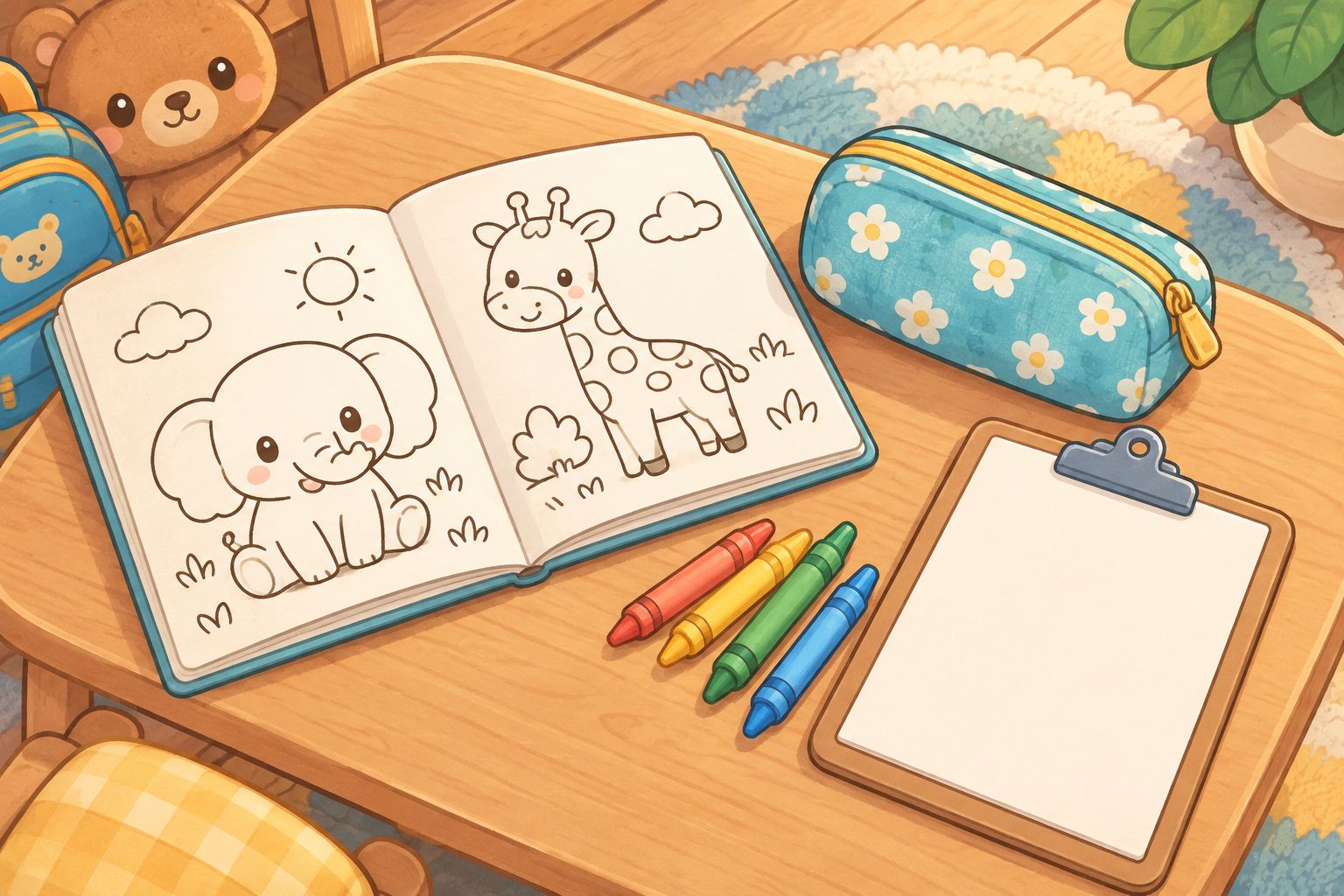
Lay out the book, drawing tools, pouch, and backing together. Then remove anything the chosen activities do not need. A page that only calls for coloring does not need a collection of craft supplies beside it.
As a packing exercise, start with 1 pouch and 4 drawing tools. These are suggested quantities, not an age-based rule. Add or remove tools after your child tries the setup, and choose age-appropriate supplies according to their labels.
A limited selection leaves fewer objects for you to manage, but it also limits color choice. Give your child a say in what stays. Do not switch to an unfamiliar tool solely because it looks easier to pack.
- Choose familiar tools: Bring supplies your child already uses comfortably.
- Contain loose items: Keep tools in a pouch that closes securely.
- Add firm backing: Support loose pages with a clipboard or suitable board.
- Check suitability: Follow supply labels and supervise their use.
5. Separate the working pages from the backup
Keep the page your child is using easy to reach, and store the backup separately. You do not need to present every option at once. A second activity is useful when your child wants a change, not something you must introduce on a schedule.
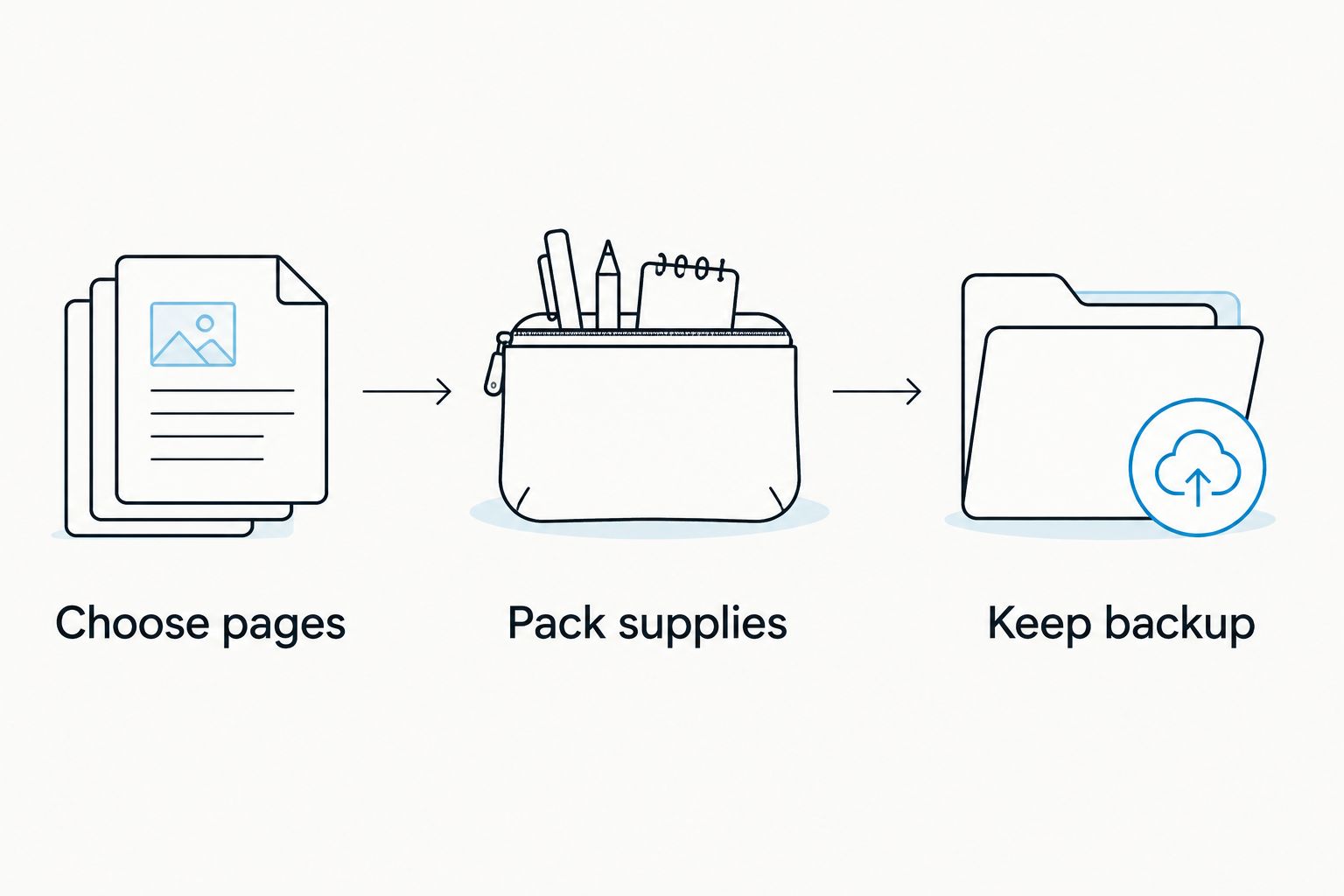
Try a simple sequence for your 2026 trip: Choose pages, Pack supplies, Keep backup. Choose the pages at home, contain the tools they require, and leave the alternative protected until you need it.
For example, pack 1 working book and 1 backup activity rather than several similar books within immediate reach. Adjust that suggestion to your journey and bag space. The aim is a manageable choice, not a tightly controlled play session.
- Choose pages: Put a familiar activity where your child can reach it.
- Pack supplies: Store its tools together instead of across several bags.
- Keep backup: Protect the alternative from spills and crumpling.
- Save unfinished work: Provide a folder or a place inside the book.
The sequence below separates preparation from the moment your child asks for something to do. It also keeps the backup from becoming another loose item on the working surface.
6. Plan how you will help and pause
Read the instructions before the trip so you know which pages need your involvement. If a task requires repeated explanation, keep it for a time when you can participate. Use simpler, familiar pages when you need to divide your attention.
You can also agree on an easy stopping point: finish the current shape, choose one final color, or simply close the book. There is no need to complete a page before moving on to another part of the journey.
Pack for pauses as carefully as you pack for play. A folder for unfinished sheets and a closing pouch make it easier to clear the space when plans change. Keep anything you need to retrieve within your own reach.
- Read ahead: Identify instructions you will need to explain.
- Offer a starting point: Suggest one small part of a busy page.
- Accept a pause: Let unfinished pages remain unfinished.
- Clear the surface: Put tools away before moving to another location.
7. Review the kit before the return journey
Before heading home, open the pouch and check the pages. Replace unusable tools if needed, remove scraps, and decide whether the same activities still interest your child. A return-trip kit does not have to repeat the outward journey exactly.
Keep a short 2026 travel note about what your child actually chose. Record specific observations, such as enjoying animal coloring or asking for help with instructions, rather than labeling an entire book a success or failure.
For your next trip, change the part that caused difficulty. If loose sheets were awkward, address how you hold them. If the theme did not interest your child, choose a different subject. Buying more books does not fix every packing problem.
- Check supplies: Remove broken or unusable items before repacking.
- Sort the pages: Separate finished work from unused activities.
- Ask your child: Find out which activity they want to keep.
- Record one adjustment: Note a specific change for the next journey.
Compare activity-book options for your trip
The best travel option is the one whose preparation and supervision needs fit your journey. Use this comparison to choose the format first, then inspect the individual pages. None of these options is automatically right for every preschool traveler.
| Option | Best for | Main advantage | Key limitation |
|---|---|---|---|
| Homemade activity pages | Parents matching a familiar task closely | You choose the subject and instructions | You create and organize the pages yourself |
| Printable workbook | Parents who want to select pages before departure | You decide which sheets to carry | Requires downloading, printing, and organizing |
| Physical coloring book | Children who want familiar, open-ended coloring | Pages stay together in the book | Coloring alone does not provide other activity types |
| Mixed activity book | Children who enjoy changing tasks | Different activities share one book | Instructions and difficulty need page-by-page review |
French Press Studios' preschool activity books selection includes the printable workbook described above; its digital format is the practical distinction to check before packing. Do not assume that printable means reusable or that every activity needs only crayons. Read the individual instructions.
For a 2026 trip with little preparation time, begin with suitable materials already in your home. Choose a printable when you have time to prepare it and want to carry selected pages rather than the whole file.
Common mistakes parents make with travel activity books
Choosing the theme without checking the task
A cheerful animal cover can attract your child while the inside activities ask for unfamiliar skills or instructions. Check the activity as well as the artwork. Use available previews to see what your child will actually be asked to do.
Packing a workbook as a completion goal
A trip does not need a finished-book target. Let your child color outside the suggested sequence, skip a page, or return to a favorite picture. Keep the experience playful rather than turning waiting time into an assignment.
Treating ages 3–7 as one difficulty level
An age range is not a description of your individual child. Choose familiar activities and inspect instructions instead of assuming the same pages will suit every sibling. Share supplies only when that arrangement works for your family.
Leaving printable preparation until departure
A PDF in your inbox is not yet a packed activity. Download it, print the pages you want, and check the result before leaving. Put the prepared sheets beside the rest of the travel kit so they are not forgotten near the printer.
FAQ
What are the best preschool activity books for travel?
The best preschool activity books for travel contain activities your child enjoys and can use in your available space. Check the actual pages, required supplies, and amount of adult help before packing.
How many activity books should I pack for my preschooler?
Start with one working book and one backup activity, then adjust for your journey and bag space. This is a packing suggestion, not a rule about how long a child will stay interested.
Are printable activity books useful for a road trip?
Printable activity books are useful when you want to choose individual pages before departure. Download and print them at home, then provide firm backing and a place to store unfinished sheets.
Is a coloring book better than a mixed activity book for travel?
A coloring book fits children who want open-ended coloring; a mixed activity book fits children who enjoy changing tasks. Check the mixed book's instructions because different activities can require different supplies or help.
Can I use the same activity book for children ages 3–7?
Choose pages for each child's interests and comfort with the task rather than relying on a shared age range. The same book does not have to mean the same page or activity for every child.
Is Wild Little Learners a physical workbook?
Wild Little Learners: Preschool–1st Grade Workbook is a printable digital PDF emailed automatically after purchase. Prepare the printed pages before your trip rather than expecting a physical book.
What should I pack with preschool activity books?
Pack suitable drawing tools, a closing pouch, and firm backing if the pages need it. Bring only the materials required by your chosen activities and follow the supplies' age and supervision guidance.
One last thing
Your most useful packing decision might be the page you leave out. Removing an activity that needs awkward supplies or constant explanation gives you a simpler kit without buying anything new. Let your child choose a favorite page to place at the front, ready for the next little pocket of waiting time.